Hotel Room Equipment Specification: A Practical Checklist for International Hospitality Projects
Specifying equipment for a hotel room is not simply a matter of choosing individual products. In an international hospitality project, every item must fit into a wider system involving room categories, quantities, dimensions, finishes, electrical requirements, installation constraints, technical documentation and delivery schedules.
A clear hotel room equipment specification can help architects, contractors, hotel groups and procurement teams compare suitable products before requesting quotations and approving the final supply.
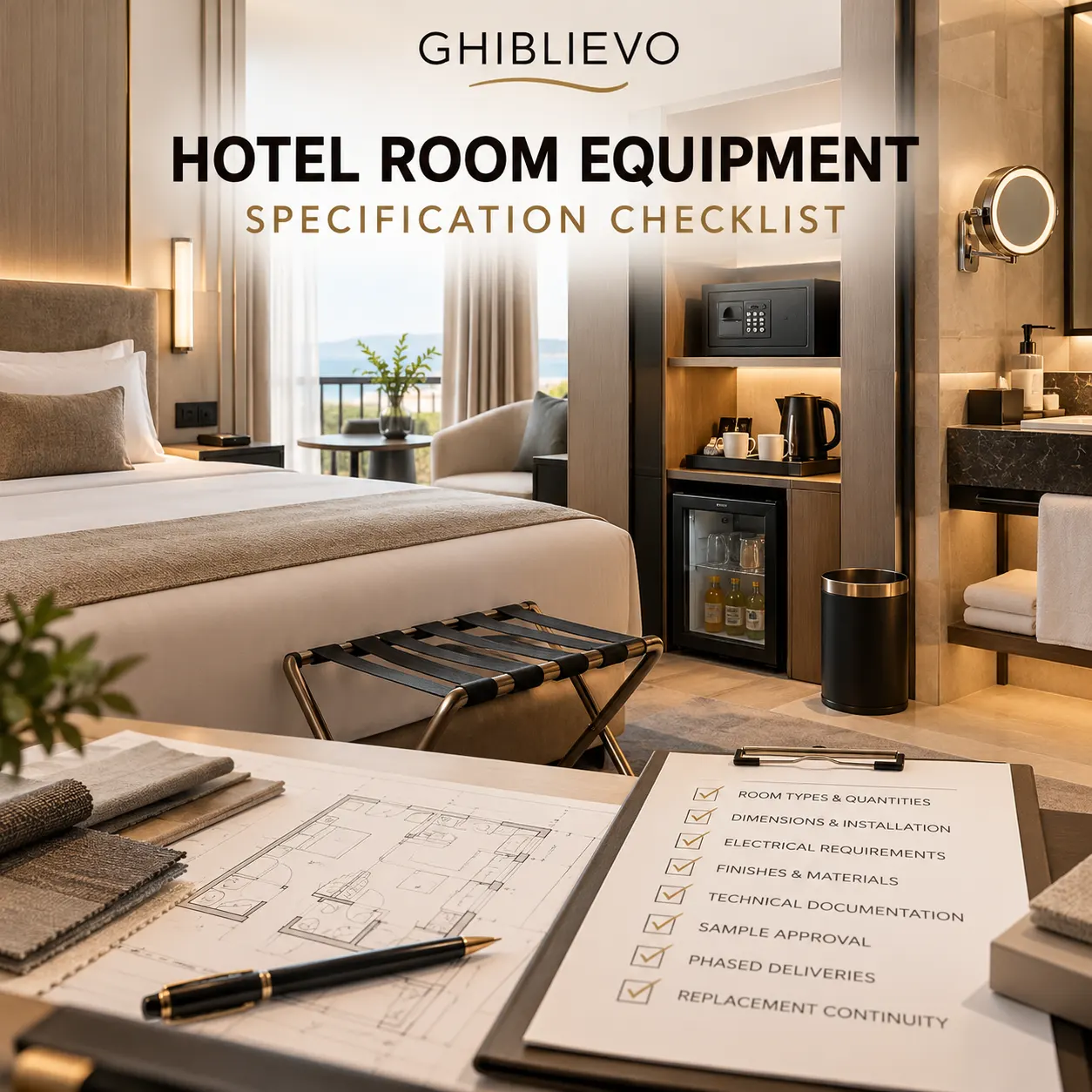
This practical checklist highlights the main information to define when selecting hotel room accessories and supplies for new hotels, renovations, resorts, serviced apartments, cruise ships and other international hospitality projects.
1. Start with room types, not individual products
Before selecting equipment, define the different room categories included in the project. A standard room, suite, accessible room, serviced apartment or cruise cabin may require different products, dimensions or quantities.
A simple room schedule can become the starting point for the entire specification:
- room type or category;
- number of rooms;
- equipment required for each room type;
- different finishes or configurations;
- special requirements for suites or accessible rooms;
- spare quantities where required.
This approach is particularly useful for projects involving hundreds of rooms because it reduces the risk of applying one specification to spaces with different layouts or operational needs.
2. Confirm quantities before requesting the final quotation
Quantity affects much more than the total order value. It can influence packaging, logistics, production planning, customisation options and delivery schedules.
Procurement teams should therefore distinguish between the total number of rooms and the actual quantity required for each product.
For example, a project with 150 rooms does not necessarily require 150 identical units of every accessory. Suites may have different equipment, some products may be installed only in selected room categories and additional units may be required as operational spares.
Providing realistic quantities from the beginning also makes a B2B quotation more useful and easier to compare.
3. Check dimensions and installation constraints
A product can meet the required design concept and still be unsuitable for the room if its dimensions or installation method are not checked in advance.
Depending on the equipment category, the specification should consider:
- overall product dimensions;
- available wall or furniture space;
- opening and operating clearance;
- mounting method;
- wall construction and fixing points;
- furniture integration;
- cable position and power outlet location;
- access for cleaning and maintenance.
A hotel luggage rack, for example, should be evaluated according to both its open and folded dimensions, available room space and the way housekeeping staff will use or store it. Wall-saver versions can also help protect surfaces when the rack is positioned close to a wall.
4. Verify electrical requirements for the destination country
Electrical equipment requires an additional level of specification, especially for international projects.
Before approving products such as hotel hair dryers, cosmetic mirrors, minibars, kettles or ironing equipment, verify the requirements of the destination market and the technical characteristics of the selected model.
Relevant information may include:
- voltage and frequency;
- plug configuration;
- rated power;
- installation type;
- electrical protection requirements;
- product certifications and available technical documentation.
These checks should take place before the final product approval rather than after the order has been placed.
5. Define finishes and materials as part of the specification
Finishes are not only an aesthetic choice. In hospitality environments they also affect coordination, maintenance and long-term consistency.
Architects and interior designers may need to coordinate bathroom and room accessories with taps, door hardware, lighting, furniture and other interior elements.
The specification should therefore identify finishes precisely rather than using generic descriptions such as “black” or “metal”. Where available, product codes, finish references, material specifications and samples provide a clearer basis for approval.
This becomes especially important when several product categories must work together across the same room or bathroom.
6. Request technical documentation before approval
For professional hospitality projects, the product image should never be the only source of information.
Depending on the product, procurement teams may need:
- technical data sheets;
- dimension drawings;
- installation instructions;
- material and finish information;
- electrical specifications;
- certifications where applicable;
- packaging and logistical information.
This documentation allows architects, contractors and procurement teams to verify compatibility before the product is included in the final room specification.
7. Evaluate products as part of the complete guest room
One of the most common specification mistakes is evaluating every accessory independently.
A hotel room normally combines several equipment categories: minibars, safes, luggage racks, waste bins, hospitality trays, kettles, hair dryers, cosmetic mirrors, bathroom accessories and other guest room products.
Looking at these items as a coordinated package can simplify procurement and reveal practical issues earlier in the project.
For example, the minibar must fit the furniture and ventilation requirements, the hospitality tray needs an appropriate surface and electrical outlet, the luggage rack requires enough operating space, and bathroom accessories must work with the selected wall finishes and installation points.
8. Use samples or mock-up rooms before large-volume orders
For larger hospitality projects, product samples and mock-up rooms can be particularly useful before final approval.
A sample allows the project team to evaluate aspects that are difficult to judge from a catalogue alone, including:
- actual finish and colour;
- material perception;
- dimensions and proportions;
- interaction with furniture and surfaces;
- ease of use;
- installation details;
- cleaning and maintenance considerations.
Once the selected equipment has been validated in the real room environment, the approved references can be used as the basis for the wider supply.
9. Consider housekeeping and daily hotel operations
Good hotel room equipment should work not only for the guest but also for the staff who clean, maintain and manage the room every day.
For this reason, specification decisions should consider easy cleaning, product accessibility, durability, replaceable components and the amount of space required around each item.
This is particularly relevant for frequently handled products such as hotel waste bins, luggage racks and hospitality trays.
A product that looks appropriate during the design phase but complicates daily operations can create avoidable costs over its service life.
10. Plan phased deliveries and site logistics
International hotel projects are not always supplied in a single shipment. New openings and renovations may involve several floors, buildings or construction phases.
The procurement plan should therefore clarify:
- required delivery dates;
- whether the order will be shipped in one or several phases;
- destination and site access;
- packaging requirements;
- storage availability;
- room or floor identification if required;
- coordination with installation teams.
Defining these points early helps the supplier evaluate the project more accurately and reduces last-minute logistical changes.
11. Think about replacements and product continuity
Hotel equipment remains in use long after the opening date. The specification should therefore consider what happens when a product or component needs to be replaced.
Depending on the project, it may be useful to define spare quantities at the initial order stage and retain clear records of product codes, finishes and approved versions.
This information can simplify future replacements and help maintain visual consistency across rooms.
12. Prepare a clear final specification for the supplier
Before requesting the final quotation, consolidate the approved information into a clear project brief.
A useful hotel room equipment specification should include at least:
- project: hotel, resort, serviced apartment, cruise ship or other hospitality property;
- destination country: particularly important for electrical products and logistics;
- room types: standard rooms, suites and other relevant categories;
- quantities: required units by product or room type;
- product references: models already selected where applicable;
- dimensions and installation: relevant space or mounting constraints;
- finishes: approved colours, materials or finish codes;
- technical requirements: including electrical information where applicable;
- documentation: technical sheets or certifications required for approval;
- samples: whether physical samples or mock-up approval are required;
- delivery: expected timing and any phased-delivery requirements.
A structured brief gives both the buyer and the supplier a more reliable basis for product selection, quotation and final approval.
Hotel room equipment for international hospitality projects
Ghibli Evo supplies professional hotel equipment for hotels, resorts, serviced apartments, cruise ships and contract hospitality projects. The range includes hotel hair dryers, bathroom accessories, cosmetic mirrors, minibars, safes, kettles, ironing centres, luggage racks, waste bins and other room accessories.
For international projects, the objective is not simply to identify individual products but to help professional buyers evaluate suitable solutions according to the room specification, quantities, destination and project requirements.
If you are preparing a new hotel, renovation or multi-room hospitality project, send us your room requirements, quantities, destination country and the product categories you need.
Contact Ghibli Evo for your B2B hospitality project
Hotel Room Equipment Specification: Frequently Asked Questions
What should a hotel room equipment specification include?
A hotel room equipment specification should identify room types, quantities, product references, dimensions, installation requirements, finishes, technical requirements, documentation and delivery needs. Electrical products may also require voltage, plug and certification information for the destination market.
Why should room types be defined before selecting hotel equipment?
Different room categories may require different products, dimensions or quantities. Defining room types first helps avoid applying the same equipment specification to standard rooms, suites, accessible rooms or other spaces with different requirements.
Should hotel equipment samples be approved before ordering?
For larger projects, samples or mock-up rooms can help verify finishes, dimensions, materials, installation details and ease of use before approving a large-volume supply.
What information is important for electrical hotel equipment?
The project team should verify voltage, frequency, plug configuration, rated power, installation method and any required technical documentation or certifications according to the product and destination market.
Can hotel room equipment be delivered in different project phases?
Yes. Hospitality projects may require phased deliveries according to floors, buildings, renovation stages or opening schedules. Delivery requirements should be communicated early so they can be considered during quotation and supply planning.
Why is product continuity important in hotel projects?
Hotels may need replacement products or components after opening. Recording approved product codes and finishes, and considering spare quantities where appropriate, can make future replacements easier and help maintain consistency between rooms.